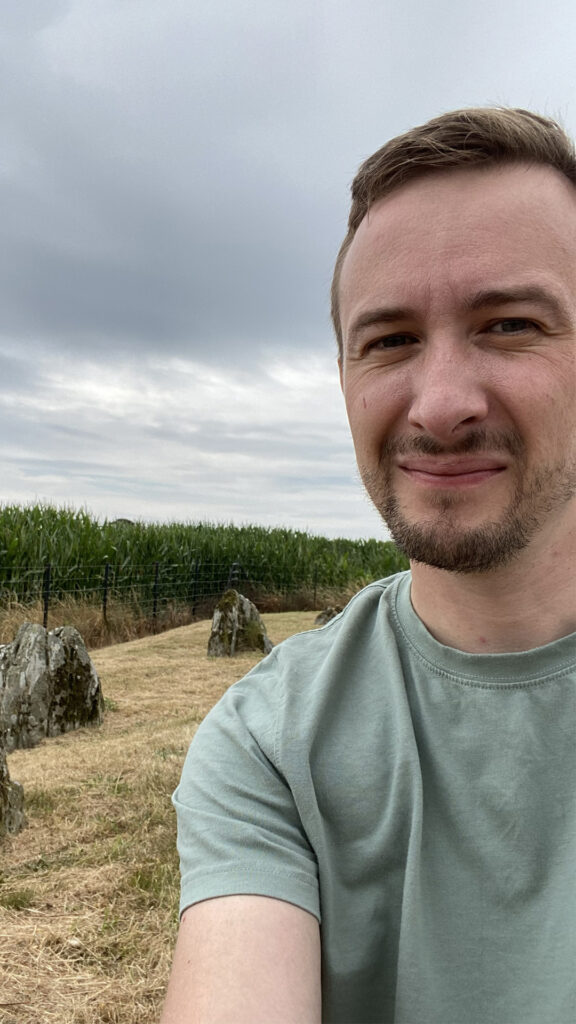

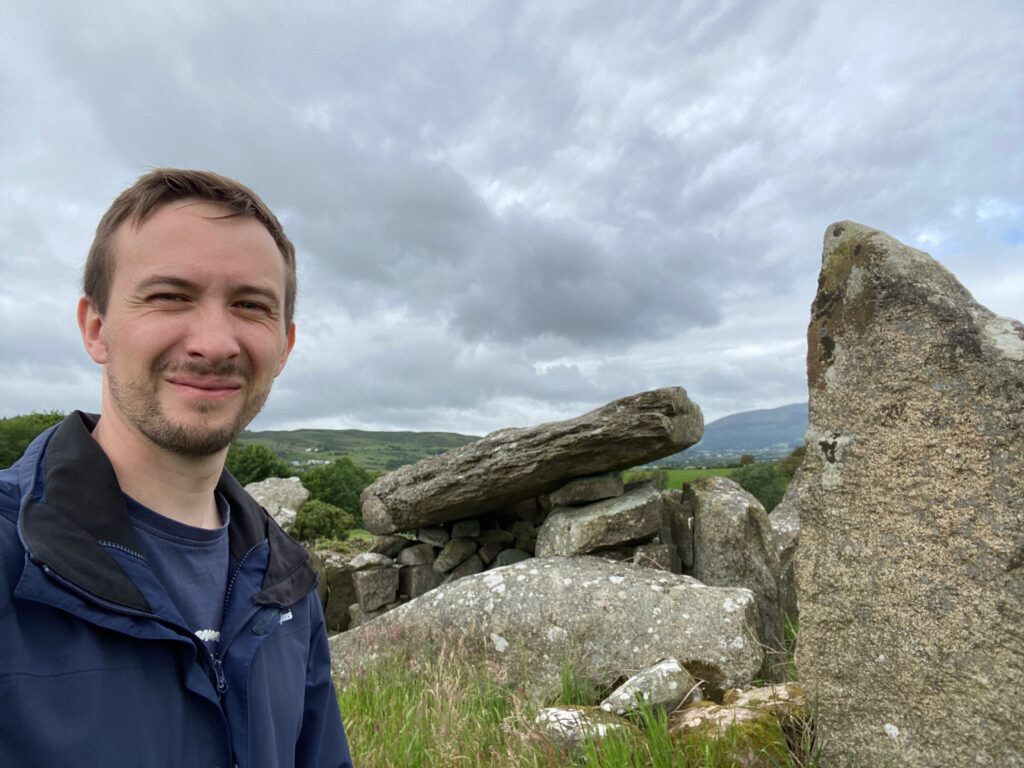
Daniel Kirkpatrick is an independent researcher and writer specializing in ancient Irish history. A former academic with a PhD in International Conflict Analysis from the University of Kent, he now publishes original research and heritage writing through his website: danielkirkpatrick.co.uk. His new book explores Northern Ireland’s spatial history through ten maps. Daniel also works as a data specialist and has built a tool exploring regional profiles across Ireland, also available on his website. Our conversation with him takes us on a journey through Irish history and explores how archaeology, the landscape, and ancient traditions can help us understand a world that is thousands of years apart from our own. Through his own research and approach, he examines the past beyond contemporary perceptions and seeks out the stories hidden behind monuments, artifacts, and traditions.
1. What is one thing about ancient Ireland that most people today misunderstand?
Context. I think most of us approach ancient Irish history through the lens of Ireland as it exists today. At least, that’s what i initially did. But i soon learned how misleading this can be. It’s like looking through binoculars the wrong way around, distorting our perspective rather than enhancing it. Places like the Neolithic Giant’s Ring in Belfast become far more fascinating when we understand its position near the River Lagan, how the enormous henge was built using only flint and bone tools, and how the passage tomb that once stood at its centre represented only a small part of a much grander ritual complex. When we view ancient Ireland as it was shaped by people responding to their own environment, with unique beliefs and practices, it gives us a whole new perspective on the present. Rather than using the past to explain the present, ancient history allows us to see our present culture more clearly.
2. When we think about the Celts, how much of what we believe is based on evidence, and how much comes from later stories, ideas and literature?
Celticness is a term that is frequently used yet rarely defined. The archaeologist Barry Cunliffe has written a fantastic short book on the subject (The Celts). It begins with a clever introduction outlining the wide range of interpretations of the word “Celt” and how it conjures up an almost meaningless collection of flawed impressions. He explains how these are often based on socio-cultural distortions that have developed throughout history and continue into the present (of which i am guilty too). This is why i have found myself gravitating more and more towards archaeology in my efforts to understand ancient Irish history. The archaeological evidence for ancient Ireland largely stands on its own terms and often does not align neatly with the later Celtic framing. However, as someone who also writes historical fiction, i recognize that the “Celtic” label does have powerful resonance and meaning, providing us with an important cultural reference point. But, returning to my answer to the first question, we simply need to be careful when applying this modern concept to ancient history.
3. What can the landscape of Ireland itself tell us about the people who lived there thousands of years ago?
An enormous amount and—dare i say it!—sometimes more than the monuments themselves. Many of the historical sites we see today are only the latest in a long succession of evolving monuments. Castles are a great example of this, such as the Norman castle at Dundrum, where the location remained strategically important throughout history. As technologies and materials evolved, so too did the fortifications. What was once likely an Iron Age hill fort was replaced by a wooden castle, later fortified with stone, and eventually transformed into a manor. History doesn’t stand still. But the landscape is a wonderful guide to identifying patterns, whether it is the association of high elevations with many defensive sites or the fact that many megaliths are often located near significant rivers. Location has always been important, and many of the factors we consider significant today have remained so throughout history.
4. How much do we actually know about the gods and supernatural beings of ancient Ireland?
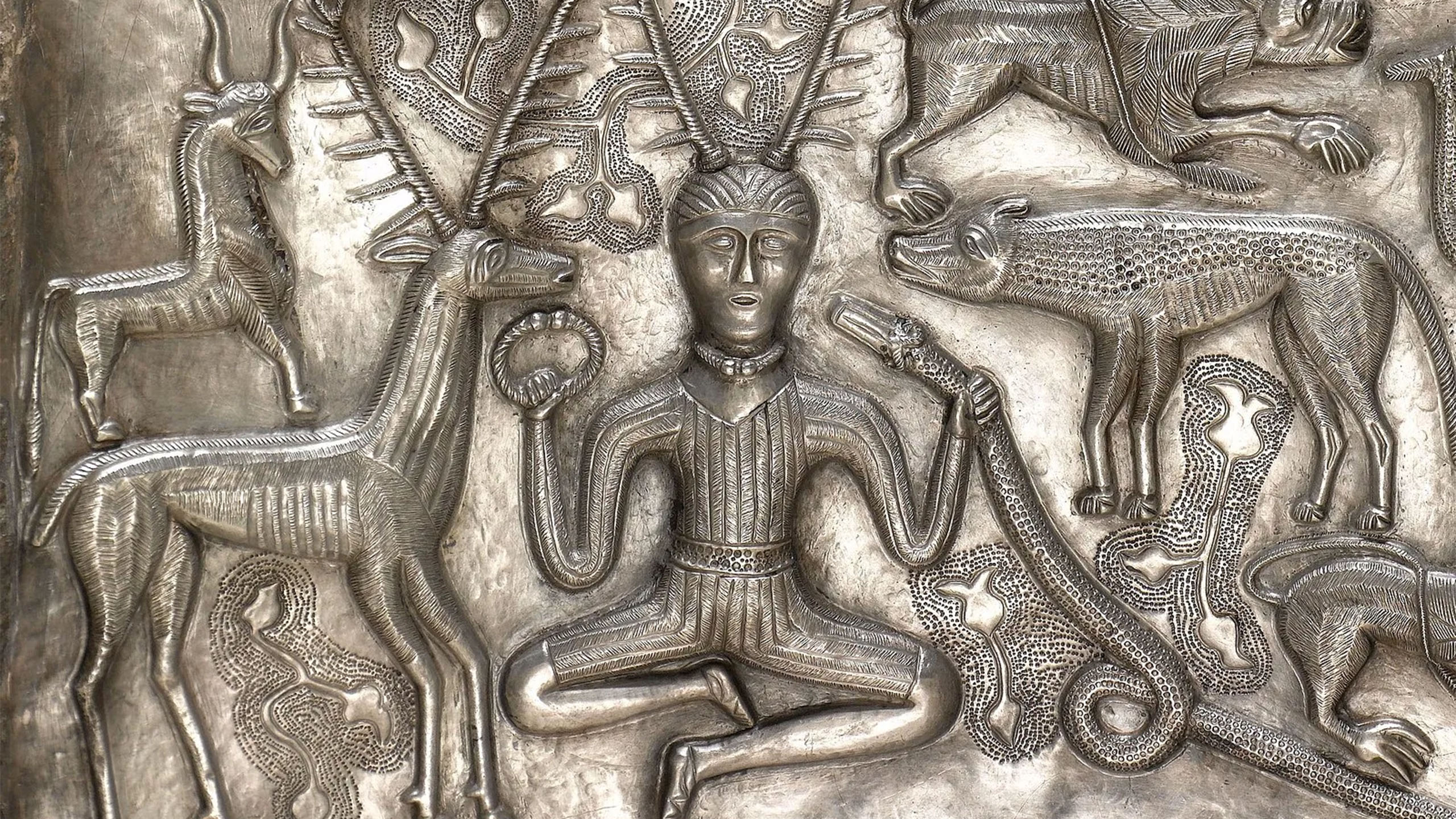
It’s very easy to overstate just how much we know. To begin with, the Irish gods were not really gods at all, at least not in the same way as the Greek, Roman, or Egyptian gods were. Much of what survives about these supernatural figures was written down by Christian monks centuries later. That does not make those stories invalid—far from it—but it does mean that we need to tread carefully. i’ve tried to piece together some of the significant myths and folklore, but i’d urge anyone interested to go directly to duchas.ie to explore its incredible collection of Irish folklore, or to celt.ucc.ie for original source material on mythology. However, archaeology can offer more indirect and, arguably, complementary evidence of ritual, repeated veneration of the dead, and monuments deliberately aligned with lunar cycles. For instance, at the megalithic site at Millin Bay, the sheer scale of deliberate post-mortem evidence in the remains buried there points to a genuinely complex belief system, even though we cannot directly reconstruct it.
5. What is one archaeological discovery in Ireland that you think deserves much more attention?
There are so many that it is genuinely difficult to say. But i recently had the pleasure of attending an open event at the excavation at Ballynahatty in Belfast, where they presented their discovery of a timber circle. The lead archaeologist explained that there was likely a cist—a stone-lined burial chamber—covered by a cairn at the centre of the circle. They discovered prehistoric pottery, flint tools, and a beautiful socketed bronze arrowhead. None of these discoveries on their own would be especially remarkable (except perhaps the arrowhead), but together they paint a vivid picture of a community that existed thousands of years ago in a place where i now live. They took the time to build these structures, clearly had rituals and beliefs that guided them, and would likely have gathered at this site at regular points in the lunar calendar. In this way, the finds are remarkable because of the story they tell. They connect us with an ancient culture that continues to surprise us.
6. What is one ancient Irish story that you believe deserves to be better known outside Ireland?
I grew up in Northern Ireland, yet it wasn’t until i was in my thirties that i learned about Ireland’s great epic, Táin Bó Cúailnge (The Cattle Raid of Cooley). This tale sits at the heart of the Ulster Cycle, a body of medieval Irish literature written down around the twelfth century. At its heart is Queen Maeve of Connacht, who launches a war against Ulster to seize a prized bull. In Ulster’s defence stands the young hero Cú Chulainn, who single-handedly holds the invading army back through a series of one-on-one combats. The story has the scale, tragedy, and sheer ambition of a true epic. But even growing up in Northern Ireland, i hadn’t heard of it, never mind the rest of the world. If any filmmakers or game developers are reading this, take note! I really do think it would merit being dramatized on a much grander scale. And it’s not simply a story worth telling for its own sake; it also provides genuine insight into how early Irish society understood honor, kingship, and conflict. So, given the audience here, i’d say that if you already love The Iliad, you’re really only one book away from discovering its Irish equivalent.
7. What can archaeology tell us about women in ancient Ireland?
Irish history is full of remarkable women, from Afrecca de Courcy, who founded Grey Abbey, to Grace O’Malley, the Pirate Queen of Connacht. Even within Irish mythology, we see iconic female characters, from Queen Maeve of Connacht, who led the war against Ulster, to the Morrigan, who was associated with warfare and shapeshifting. But for me, it is the structural evidence that best illustrates this, such as that found in the Brehon Laws—the Irish legal system dating back to the 7th century (and earlier). The laws concerning divorce are particularly interesting, as they stated that if a wife divorced her husband, she retained whatever property she had brought into the marriage, thereby protecting her financial security and that of her family, to whom she would return. Of course, property was not viewed in our modern, individualistic way, but rather as something belonging to the community. Therefore, for a wife to retain her property was likely a way of protecting the wealth and security of her clan, not merely herself. That said, when compared with other historical contexts of the time, this suggests that Irish women held a more equitable status alongside men than women in many other cultures.
8. What is the biggest myth about the Celts that you would like to correct?
There are lots. But, to be honest, i’m not really interested in “correcting” history as much as discovering it. i’ve made plenty of mistakes myself. But it’s this process of discovery, and the challenge of trying to research things—many of which seem mysterious and unknowable—that i enjoy and want to share. There’s a danger of becoming too focused on any one piece of evidence or on a single discipline. Answers are to be found in breadth as much as in depth. For me, that’s far more important, and it’s why i spend so much time trying to share history with others.
9. What is one discovery from your research that you wish more people knew about?
Exploration. Ireland is full of history, and yet so few of us have taken the opportunity to explore it. When i was an academic, i rightly spent years reading and studying, but now it is through physically exploring these sites myself that i am beginning to feel that I understand our history. And I’m not alone. I constantly receive messages from others sharing their own experiences of exploration, and i honestly love it. I know that’s probably not the answer you’re looking for, but i truly believe that history is meant to be experienced, not simply studied. And Ireland offers one of the most beautiful settings in which to do so.
10. What is one thing about ancient Ireland that you would like every reader to remember after reading your work?
See the big picture. Each site, story, and artifact gives us an impression, not a conclusion. As i learn about new sites and conduct further research, I’m constantly having to revise what i previously thought and wrote. As research evolves, so too should our perspective, and that’s why it’s so important to keep learning. I can only point to others who are much smarter and better informed than myself, but i love doing so and will continue to do so for as long as i can.